The Kiswah: The Black and Gold Cloth of the Kaaba, and the Art It Inspires

Anyone who has seen the Kaaba, in person or in a photograph, remembers the cloth before anything else: deep black, with a band of gold writing running round it. That covering is the Kiswah. It is one of the most recognised works of calligraphy in the world, and it has shaped what many people picture when they think of Islamic art.
What the Kiswah is made of
The Kiswah is woven from silk that is dyed black, and its inscriptions are embroidered by hand in gold and silver thread. It uses several hundred kilograms of silk; Saudi figures reported in the press give about 120 kg of gold thread and 100 kg of silver thread. The finished cloth covers roughly 658 square metres and is sewn together from dozens of long panels.
Since the 1960s it has been made in Makkah, today at the King Abdulaziz Complex for the Holy Kaaba Kiswa. For centuries before that, it was woven in Egypt and carried to Makkah with the pilgrim caravan.
The belt and the door curtain
- The hizam (belt). About two thirds of the way up, a band roughly 47 metres long and 95 centimetres wide runs around all four sides. It is made of sixteen pieces, four on each side, and carries Quranic verses in gold and silver thread.
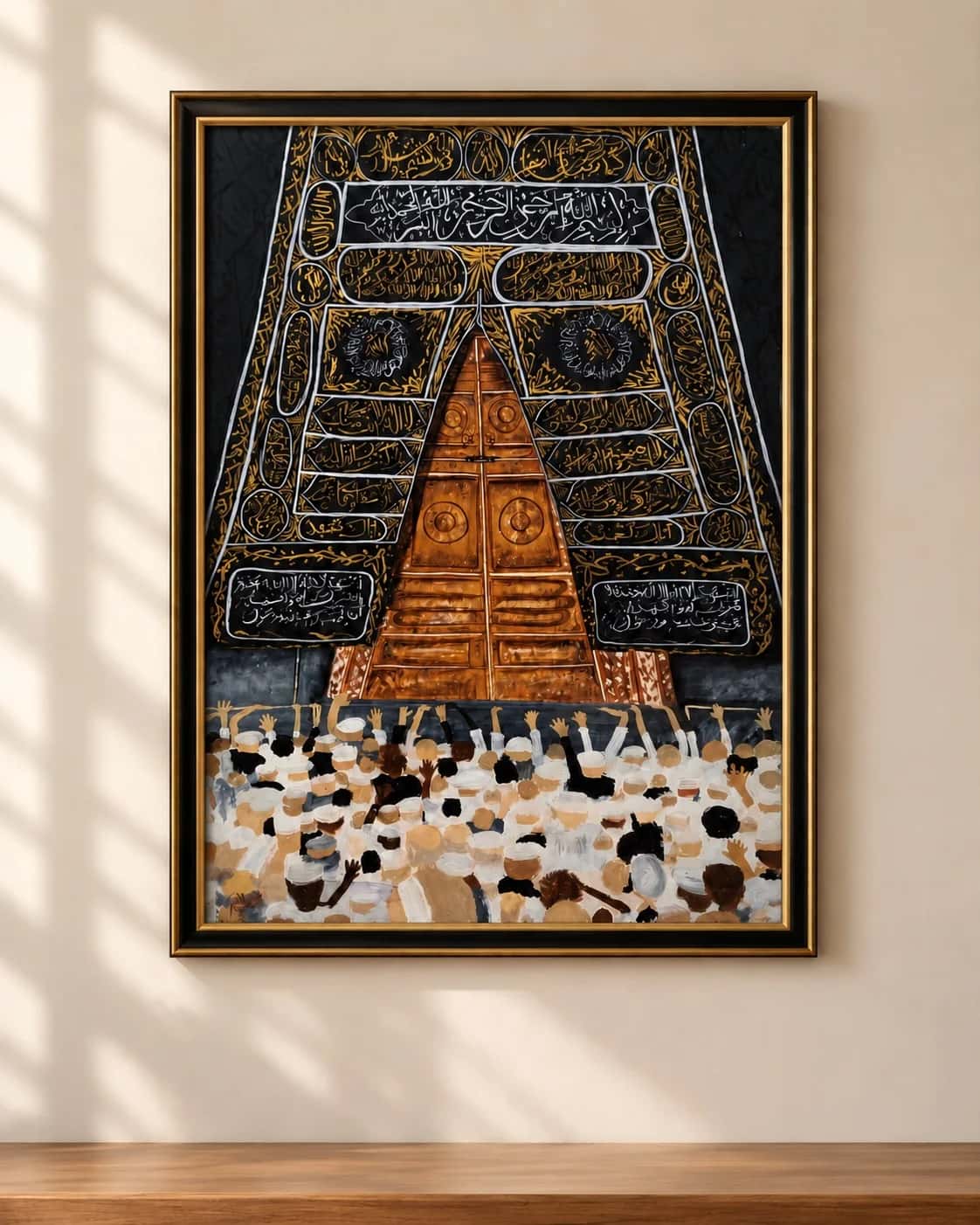
- The sitara (door curtain). The curtain over the door of the Kaaba is the most richly decorated part, densely embroidered with verses and ornamental panels.
- The script. The lettering is in bold, interlaced thuluth, a script designed to be read at a distance. Our guide to Arabic calligraphy scripts explains how to recognise it.
When it is changed
The Kiswah is replaced once a year. For a long time this was done on the 9th of Dhul Hijjah, the Day of Arafah, while the pilgrims were away from Makkah. In 2022 the date was moved, and the new Kiswah is now put in place on the 1st of Muharram, the first day of the Islamic year. The old cloth is cut into pieces, which are kept, displayed or given as gifts.
A covering older than Islam
The custom of covering the Kaaba is older than Islam, and early coverings were made from Yemeni textiles in different colours. Historical accounts record that the caliph Umar sent a covering of white Egyptian linen. Black became the settled colour in later centuries. The Quran itself records the moment the House was built:
“And [mention] when Abraham was raising the foundations of the House and [with him] Ishmael, [saying], "Our Lord, accept [this] from us. Indeed You are the Hearing, the Knowing.” (Al-Baqarah 2:127)
Why artists return to it
The Kiswah brings together three things that painters love: a strong, simple palette of black, gold and silver; the weight and fold of heavy cloth; and calligraphy on a grand scale. A Kiswah-inspired painting does not copy the cloth. It borrows the colours, the pleats and the banded layout to bring the feeling of standing before the Kaaba into a room.
- Kaaba Kiswah-inspired black and gold canvas: textured black folds with gold calligraphy bands.
- Kaaba door and pilgrims canvas: the golden door framed by the black curtain, with pilgrims in white below.
- More in Kaaba art and black and gold art.
Hanging a Kaaba piece
These are natural choices for a prayer room or the main wall of a living room, and they are among the most appreciated gifts for someone returning from Hajj or Umrah. Dark, textured surfaces look best with light from the side; see our guide to lighting artwork and gift ideas for a returning pilgrim.
Sources
- Quran translation: Saheeh International, as shown in the InkByHand Verse Library.
- Wikipedia: Kiswah (materials, dimensions, belt, history and place of manufacture).
- Gulf News: Saudi Arabia replaces Kaaba's Kiswa on Muharram 1 (date of replacement, gold and silver thread).
Artwork in this article

Kaaba Kiswah-Inspired Black & Gold Textured Canvas Art