Islamic Geometric Patterns: How Stars and Tiles Are Built

Look closely at the tiles of an old mosque, a carved wooden door or the border of a Quran page, and you will find stars locked together in patterns that seem far too complicated to draw by hand. They were drawn by hand, with two simple tools. Understanding how makes the patterns even more impressive, and helps explain why they suit calligraphy so well.
Everything starts with a circle
Traditional craftsmen worked with a compass and a straight edge. They began with a circle, divided its edge into equal parts, and joined the points with straight lines. Divide the circle into six and you get hexagons and six-pointed stars; into eight, the eight-pointed star seen across the Islamic world; into ten or twelve, the more intricate stars of Iran, Central Asia and Morocco.
From one star to a whole wall
The unit is then repeated. Because the shapes fit together without gaps, a property mathematicians call tessellation, the pattern can spread across a wall, a ceiling or a page in every direction. Crafts gave these patterns different names: girih, a Persian word meaning knot, for the interlaced strapwork of Iran; zellige for the cut-tile mosaics of Morocco.
Some medieval designs are remarkably advanced. In 2007 a study in the journal Science showed that the tiling on the fifteenth-century Darb-i Imam shrine in Isfahan follows a kind of pattern that Western mathematicians described only in the twentieth century.
What the patterns express
The patterns have no single official meaning, and craftsmen left few written explanations. They are widely understood, though, to reflect ideas that matter in Islam: order beneath apparent complexity, unity within multiplicity, and the infinite, since a pattern that could go on for ever points beyond its own edges. They also solved a practical question: how to decorate sacred spaces richly without images of living beings.
Geometry and calligraphy together
Geometry rarely stands alone. It frames and carries the written word.
- Medallions. A star or lobed shape holds a word or a Name, as in the 99 Names mosaic canvas, where each Name sits in its own tile.
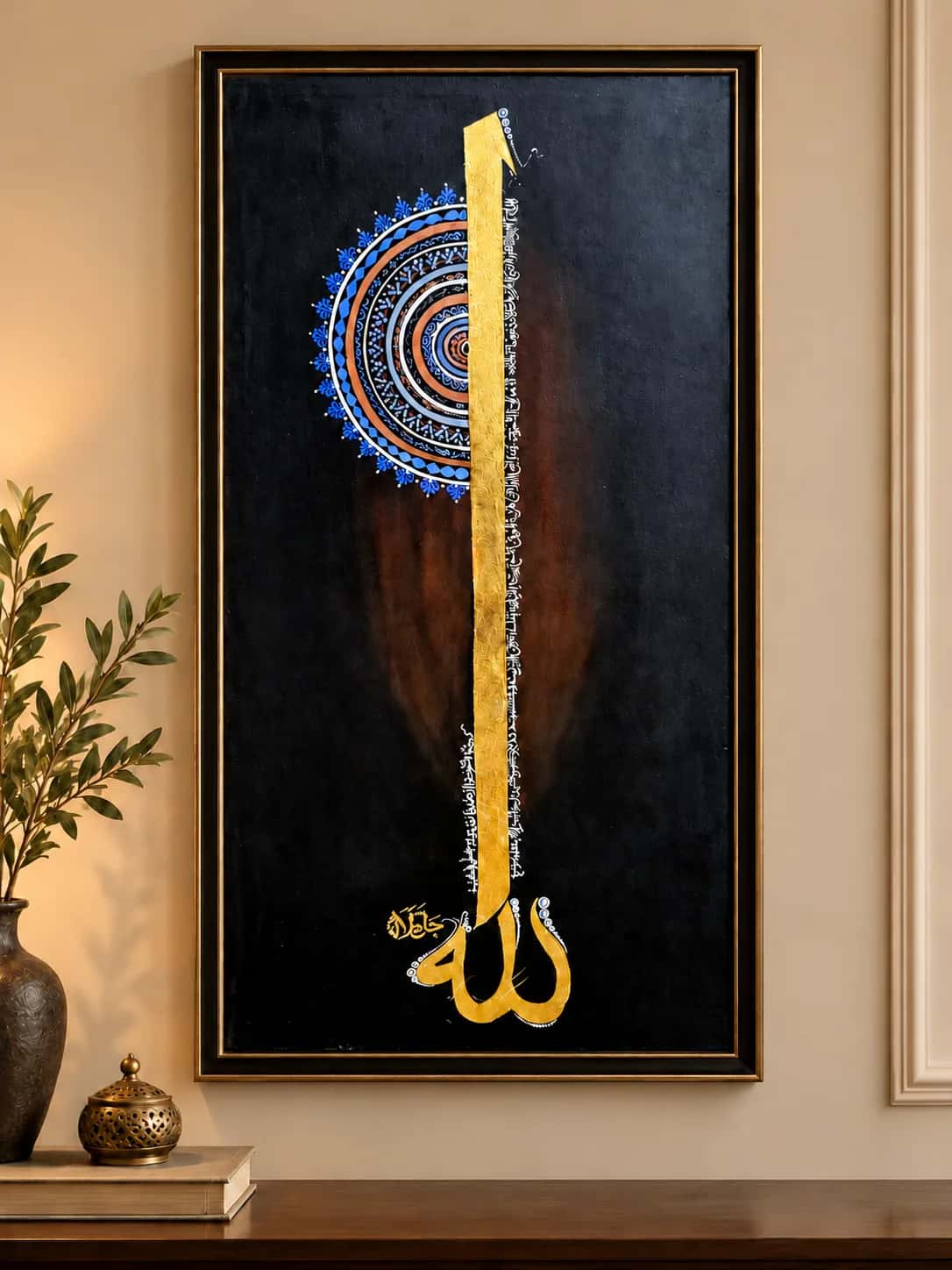
- Rosettes and mandalas. A circular pattern balances a tall line of script, as in Allah calligraphy in black and gold.
- Borders. A band of repeating pattern frames a verse the way illumination frames a manuscript page.
- Square Kufic. Here the letters themselves become geometry, built from straight lines on a grid. See the guide to Arabic calligraphy scripts.
Choosing a geometric piece
- Busy room, simple pattern. If your rugs and cushions are patterned, choose artwork where the geometry is a quiet accent.
- Plain room, rich pattern. A plain wall and plain furniture can carry a dense mosaic of colour.
- Mind the viewing distance. Fine pattern is for looking at closely. Hang it where people can walk up to it.
- Pick up a colour. Geometric pieces often use several colours; repeat one of them elsewhere in the room. See what colours mean in Islamic art.
Read about the other two languages of Islamic ornament in our article on floral motifs and the history of Islamic calligraphy, or browse 99 Names of Allah art to see pattern and text combined.
Sources
- Peter J. Lu and Paul J. Steinhardt, “Decagonal and Quasi-Crystalline Tilings in Medieval Islamic Architecture”, Science, 2007.
- Wikipedia: Islamic geometric patterns.
Artwork in this article
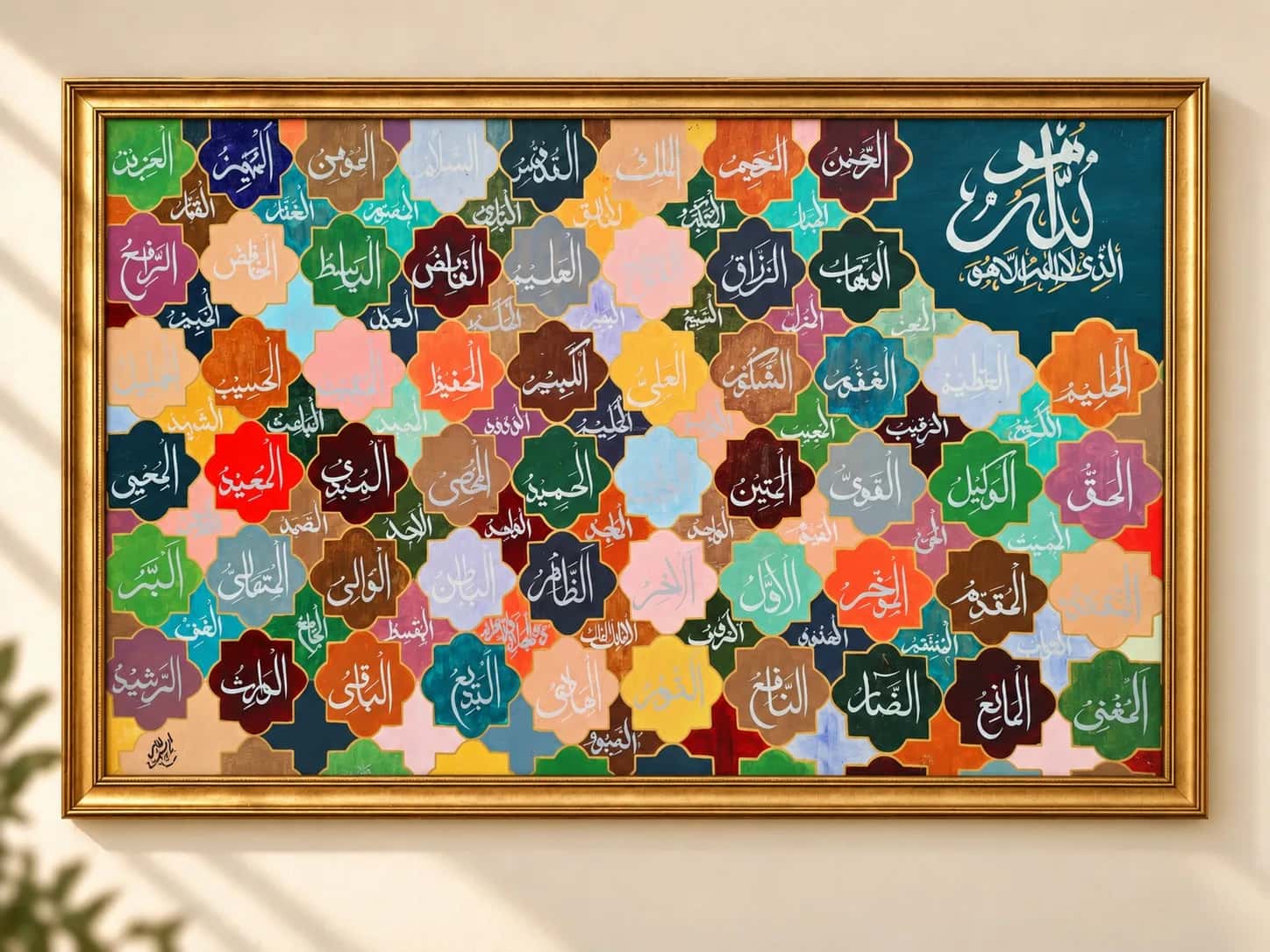
99 Names of Allah Mosaic Calligraphy Canvas