Duas of the Prophets in the Quran: Seven Supplications to Live With

The Quran does not only tell us that the prophets prayed. It records their words. Because these supplications are short, personal and tied to a moment in a story, they make some of the most meaningful calligraphy pieces. Here are seven, each with the situation it came from.
1. Musa, a stranger with nothing
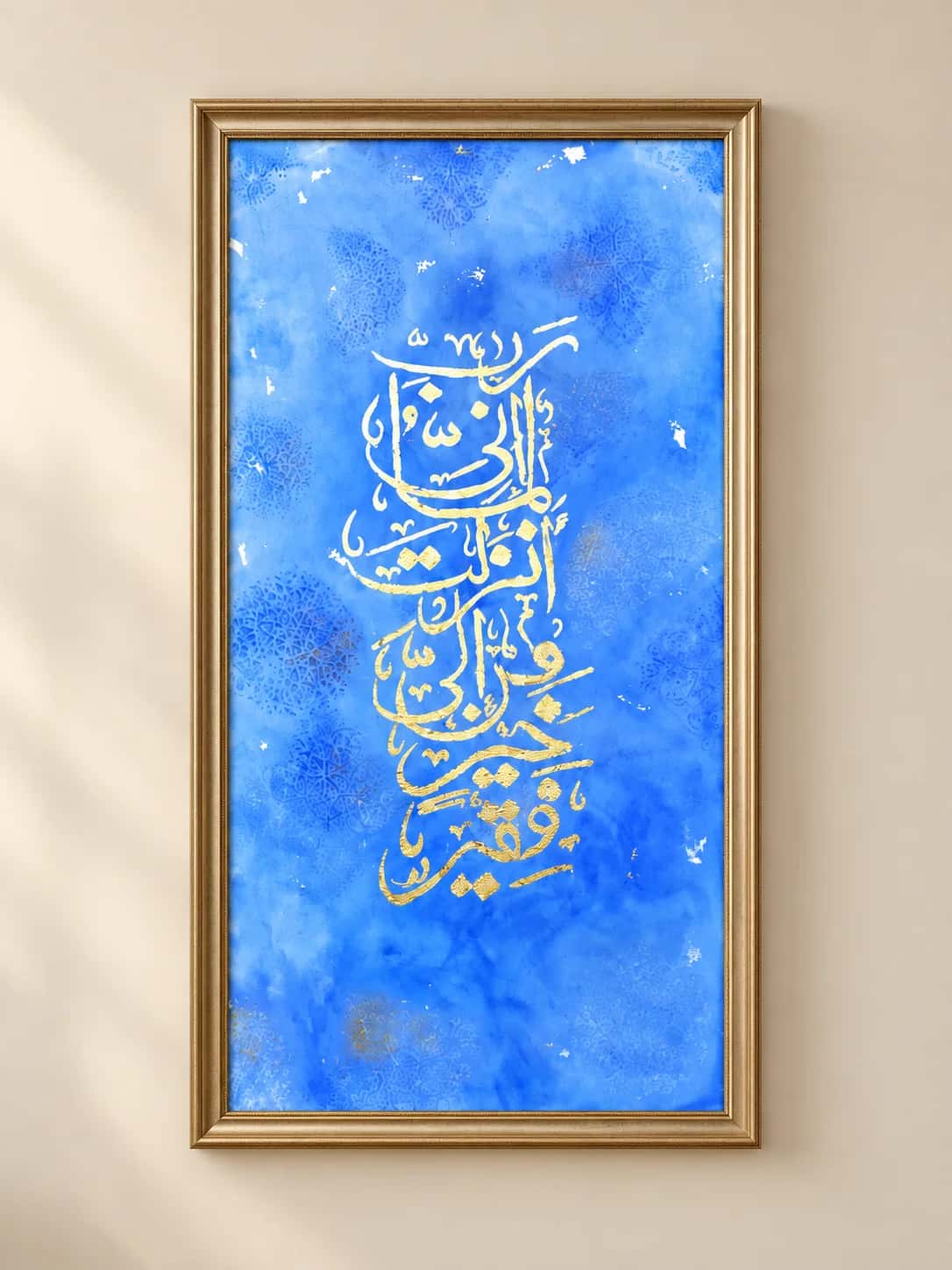
“So he watered [their flocks] for them; then he went back to the shade and said, "My Lord, indeed I am, for whatever good You would send down to me, in need."” (Al-Qasas 28:24)
Musa, peace be upon him, had fled Egypt and arrived in Madyan alone, without work, home or family. After helping two women water their flock, he sat in the shade and said this. Within the same passage he is offered work, a home and marriage. It is a dua for anyone in need of provision. See the Rabbi Inni Lima Anzalta canvas and the verse page.
2. Musa, before a hard task
“[Moses] said, "My Lord, expand for me my breast [with assurance] And ease for me my task And untie the knot from my tongue That they may understand my speech.” (Ta-Ha 20:25–28)
Sent to speak to Pharaoh, Musa asks for a calm heart and clear speech. Students say it before exams and speakers before they stand up. Read the verses.
3. Yunus, in the darkness
“And [mention] the man of the fish, when he went off in anger and thought that We would not decree [anything] upon him. And he called out within the darknesses, "There is no deity except You; exalted are You. Indeed, I have been of the wrongdoers."” (Al-Anbiya 21:87)
Known in South Asia as Ayat-e-Karima, this is the prayer of Yunus, peace be upon him, from inside the fish. The Prophet ﷺ said that no Muslim calls upon Allah with these words for anything without Allah answering him (Jami' at-Tirmidhi 3505). Read the verse.
4. Ibrahim and Ismail, building the Kaaba
“And [mention] when Abraham was raising the foundations of the House and [with him] Ishmael, [saying], "Our Lord, accept [this] from us. Indeed You are the Hearing, the Knowing.” (Al-Baqarah 2:127)
Even while raising the foundations of the House, father and son ask only that the work be accepted. It suits a new home, a new mosque or any project begun for the sake of Allah. Read the verse.
5. Ibrahim, for his family's prayer
“My Lord, make me an establisher of prayer, and [many] from my descendants. Our Lord, and accept my supplication.” (Ibrahim 14:40)
A parent's dua, often chosen for a prayer room or a family living room. Read the verse.
6. Ibrahim, asking for a righteous child
“My Lord, grant me [a child] from among the righteous."” (As-Saffat 37:100)
Short enough to paint large, and a gentle gift for a couple hoping for a child or welcoming one. Read the verse.
7. Muhammad ﷺ, for knowledge
“So high [above all] is Allah, the Sovereign, the Truth. And, [O Muhammad], do not hasten with [recitation of] the Qur'an before its revelation is completed to you, and say, "My Lord, increase me in knowledge."” (Ta-Ha 20:114)
Rabbi zidni ilma is the one thing the Prophet ﷺ is told in the Quran to ask for more of. It belongs above a desk, in a library or in a child's study corner. Read the verse.
Choosing and placing a dua
- Match the dua to the person. A job seeker, a student, new parents and a family moving house each have a dua above that is theirs.
- Keep it short. Most of these have a central phrase of a few words. Painted large, it stays readable on a small canvas.
- Hang it where it will be said. A dua is meant to be spoken. Place it where you will actually read it aloud: by the desk, near the prayer mat, beside the door.
Browse dua wall art, read five verses about trusting Allah, or have a dua painted with a name and date through the custom artwork process.
Sources
- Quran translation: Saheeh International, as shown in the InkByHand Verse Library.
- Jami' at-Tirmidhi 3505.
Artwork in this article