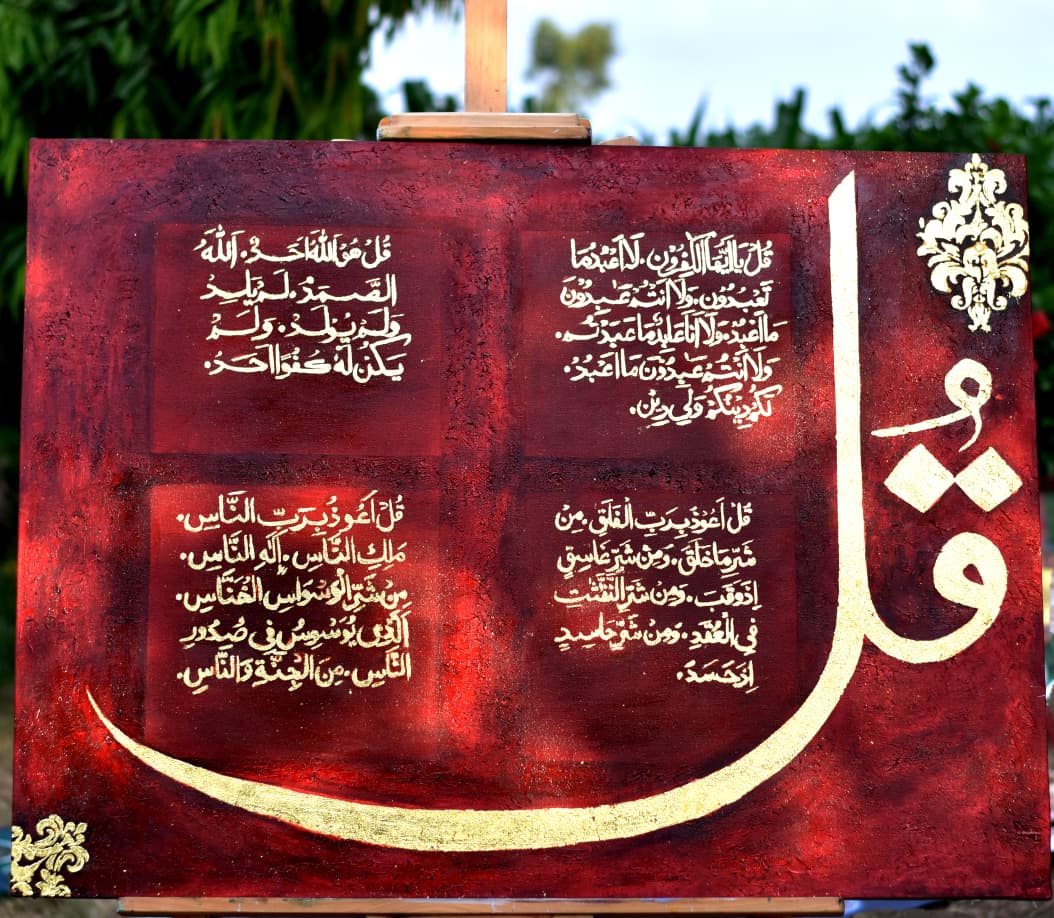
The Four Quls: What Each Surah Means and Why They Hang Together

In South Asia they are known as the Chaar Qul: four short surahs near the end of the Quran that each open with the command Qul, “Say”. They are among the first surahs children memorise, and together they make one of the most requested calligraphy pieces. Here is what each one says and how to choose a painting of them.
Which surahs are the Four Quls?
- Surah Al-Kafirun (109), six verses. A clear statement that worship belongs to Allah alone. It ends: “For you is your religion, and for me is my religion."”
- Surah Al-Ikhlas (112), four verses. The purest description of who Allah is.
- Surah Al-Falaq (113), five verses. A prayer for refuge from harm that comes from outside a person: darkness, envy and those who wish ill.
- Surah An-Nas (114), six verses. A prayer for refuge from the harm that works inside a person: the whisper that pulls away from good.
Together they hold 21 verses. Read all four with their Arabic on the Four Quls page of the Verse Library.
Al-Ikhlas: a third of the Quran
“Say, "He is Allah, [who is] One, Allah, the Eternal Refuge. He neither begets nor is born, Nor is there to Him any equivalent."” (Al-Ikhlas 112:1–4)
The Prophet ﷺ said of this surah that it is equal to one third of the Quran (Sahih al-Bukhari 5013). Scholars explain that the Quran speaks of three great subjects, belief in Allah, His commands, and the stories of earlier peoples, and that this surah is entirely about the first.
Al-Falaq and An-Nas: the two surahs of refuge
The last two surahs of the Quran are called al-Mu'awwidhatayn, the two that seek refuge. Aishah reported that every night when the Prophet ﷺ went to bed he would recite Al-Ikhlas, Al-Falaq and An-Nas, blow lightly into his palms and pass them over his body (Sahih al-Bukhari 5017). Many families keep this habit and teach it to their children.
These narrations describe recitation. Artwork of the surahs is a reminder to recite them, not a substitute for it.
How the Four Quls are arranged in art
- Four blocks with one large Qul. The four surahs sit in four panels of text, and the word Qul, which they share, is painted once in large letters. It is the classic layout and the easiest to read. See the Four Quls in maroon and gold.
- Four bands or four canvases. Each surah has its own band or its own canvas. A set of four suits a long wall or a staircase.
- With Ayatul Kursi. Because they are recited together morning and evening, some pieces place Ayatul Kursi at the centre with the Quls around it. Read our Ayatul Kursi article for more.
Buying advice
- Count the verses. A complete piece has all 21 verses, usually with the Basmala before each surah.
- Check legibility. Four surahs is a lot of text. Ask for a close photograph so you can see that the small lettering is clean.
- Choose the wall first. A landscape piece suits the space above a sofa; a tall piece suits an entrance or a narrow wall between doors. The size guide explains the two-thirds rule.
Browse Quran protection verses to see the Quls beside other verses families keep at the heart of the home, or ask the studio to paint the four surahs in your own colours through the custom artwork process.
Sources
- Quran translation: Saheeh International, as shown in the InkByHand Verse Library.
- Sahih al-Bukhari 5013 and Sahih al-Bukhari 5017.
Artwork in this article