Ayatul Kursi: Meaning, Virtues and Where to Hang It at Home
If a Muslim home has only one verse on its walls, it is very often Ayatul Kursi. It is verse 255 of Surah Al-Baqarah, and its name, the Verse of the Throne, comes from the word kursi in its second half. This article explains what the verse says, what is authentically reported about it, and how to choose a painting of it that you will be glad to live with.
What the verse says
“Allah - there is no deity except Him, the Ever-Living, the Sustainer of [all] existence. Neither drowsiness overtakes Him nor sleep. To Him belongs whatever is in the heavens and whatever is on the earth. Who is it that can intercede with Him except by His permission? He knows what is [presently] before them and what will be after them, and they encompass not a thing of His knowledge except for what He wills. His Kursi extends over the heavens and the earth, and their preservation tires Him not. And He is the Most High, the Most Great.” (Al-Baqarah 2:255)
Read slowly, the verse moves through four ideas. It opens with who Allah is: the only deity, the Ever-Living, the Sustainer of everything that exists. It then says what never touches Him: tiredness or sleep. Next comes His ownership and knowledge of the heavens and the earth, and the fact that no one intercedes with Him except by His permission. It closes with His Kursi, which extends over the heavens and the earth, and two of His names: the Most High, the Most Great.
You can read the Arabic with transliteration on the Ayatul Kursi page of our Verse Library.
Why it is called the greatest verse
The Prophet ﷺ once asked his companion Ubayy ibn Ka'b which verse of the Book of Allah was the greatest. Ubayy answered with Ayatul Kursi, and the Prophet ﷺ struck him gently on the chest and said, “May knowledge be pleasant for you, Abul-Mundhir” (Sahih Muslim 810).
In another well-known narration, Abu Hurairah was told that whoever recites Ayatul Kursi when going to bed will have a guardian from Allah over them until morning, and the Prophet ﷺ confirmed that this was true (Sahih al-Bukhari 2311). This is why so many families recite it at night and teach it to their children early.
These narrations are about reciting the verse. A painting does not replace recitation; it keeps the words in front of the people who live in the house, which is its real value.
Choosing an Ayatul Kursi painting
- Give it room. This is one of the longest single verses in the Quran. On a small canvas the letters become too fine to read, so choose a larger size than you would for a short phrase. The size guide shows how to measure your wall.
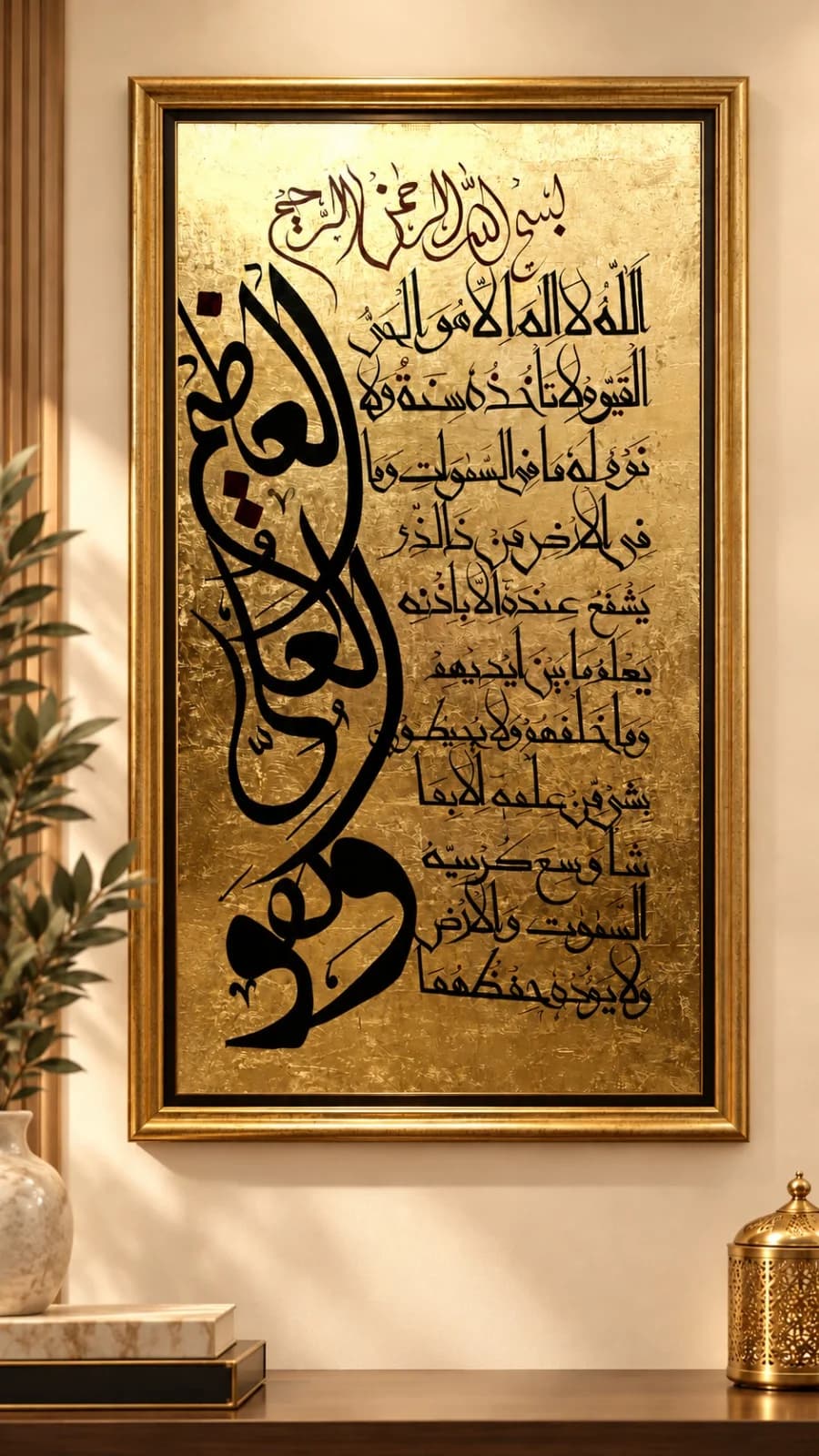
- Decide between reading and impact. Even lines of clear script let guests read the verse. A composition that enlarges one phrase, such as the closing words wa Huwal-Aliyyul-Azim, reads as a bold statement from across the room.
- Pick a palette for the room. Gold on black is formal, gold on green is traditional, and black on gold or ivory is the easiest to read. Compare the pieces in Ayatul Kursi art.
- Check the text. Whoever makes it, compare the finished lettering with a printed mushaf, word by word, before you hang it.
Where to hang it
The most common places are the main living room wall and the entrance, where the family and guests pass every day. Choose a clean wall at or above eye level, away from the floor and from anywhere it could be splashed or knocked. Scholars have discussed the manners of displaying Quranic text; our guide to hanging Quran verses with respect summarises the main points, and the entrance and living room pages show pieces suggested for those spaces.
Pairing it with other verses
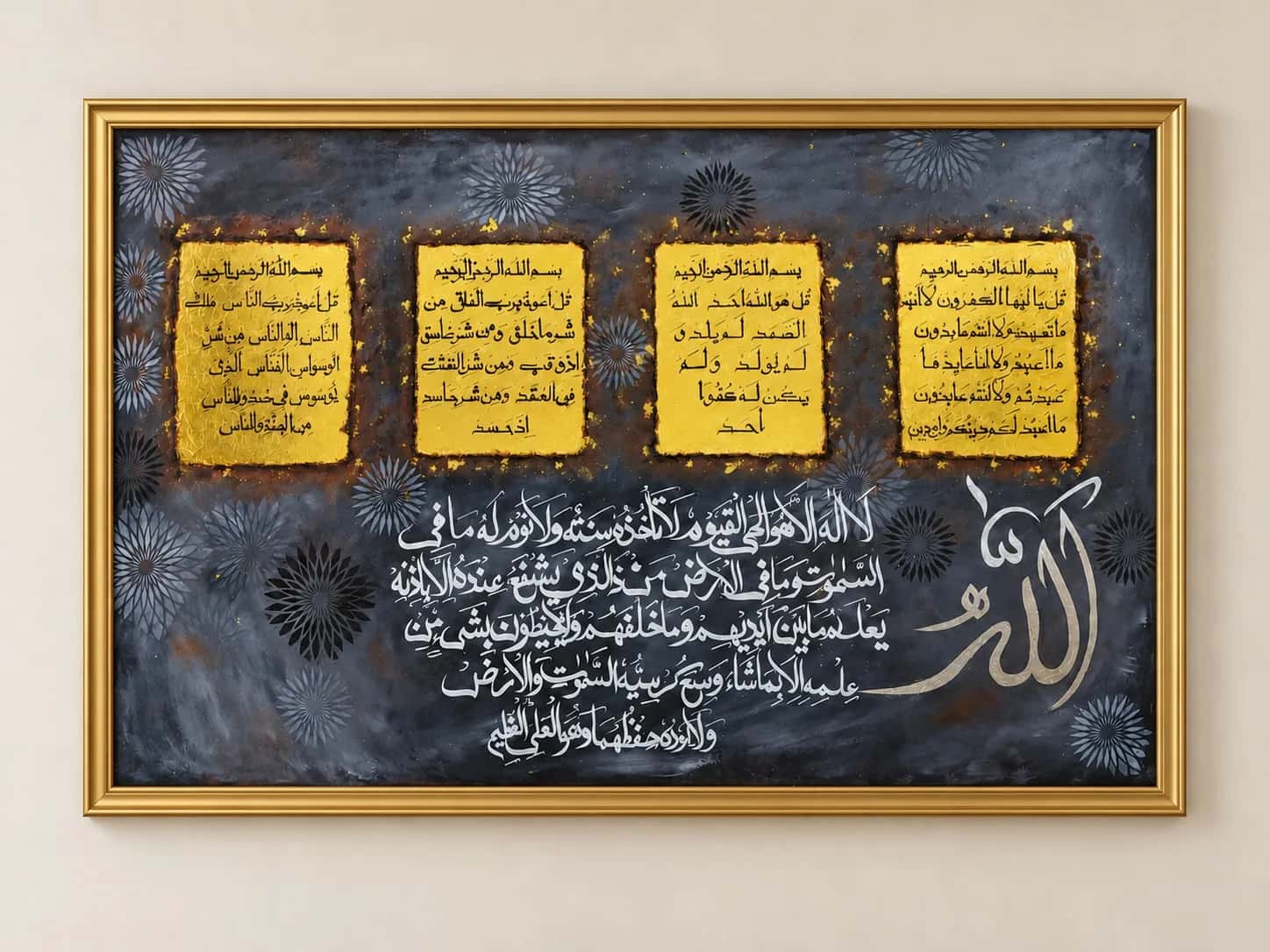
Ayatul Kursi is often hung with the Four Quls, since many people recite them together in the morning and evening. Read our article on the Four Quls, or see a single canvas that carries both: Ayatul Kursi and Four Quls in black and gold.
If you would like the verse in your own colours and size, the studio can paint it to order through the custom artwork process.
Sources
- Quran translation: Saheeh International, as shown in the InkByHand Verse Library.
- Sahih Muslim 810 and Sahih al-Bukhari 2311.
Artwork in this article