Allah Calligraphy: Why the Name Stands Alone, and Where to Place It

Calligraphers call it Lafz al-Jalalah, the Word of Majesty. The name Allah is the most written word in Islamic art, found on mosque walls, coins, textiles and the first page a child practises. As wall art it is also the simplest: one word that needs no explanation in a Muslim home.
Four letters, endless variations
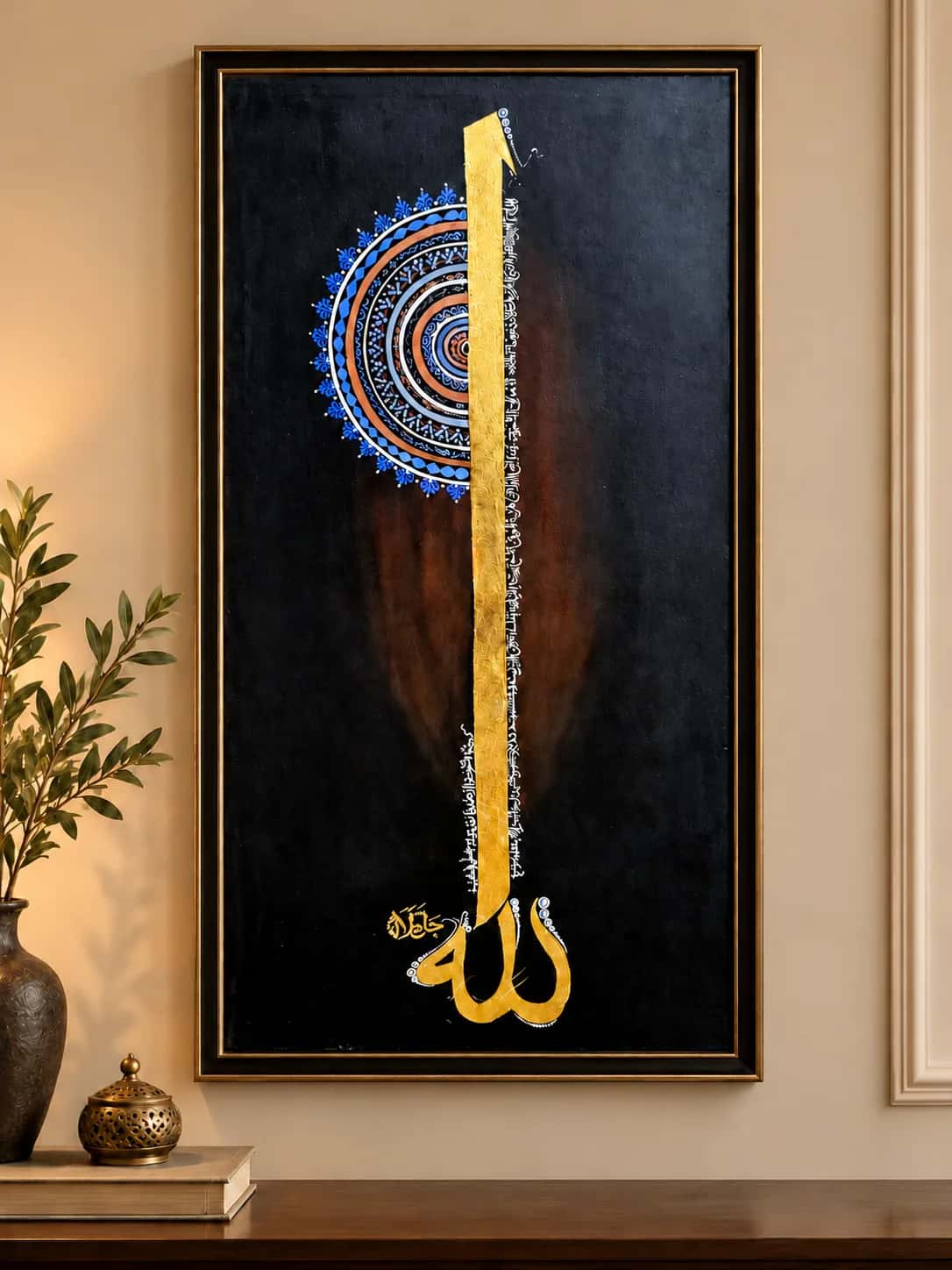
In Arabic the name is written with an alif, two lams and a ha. Three tall vertical strokes and one rounded letter give calligraphers a natural rhythm to work with, which is why the name can be stretched into a tall, narrow composition, compressed into a circle, or mirrored and repeated as pattern.
- Tall and vertical. The uprights are lengthened so the word rises like a column. This suits narrow walls and entrances.
- Round. The word is set inside a circle or medallion, a form seen in mosques around the world.
- Square Kufic. The letters are built from straight lines on a grid, close to architectural tilework.
- With the Names. The name Allah is painted large with the ninety-nine Names around it. Read more in our guide to 99 Names wall art.
To learn how the main scripts differ, see the guide to Arabic calligraphy scripts.
A name that describes itself
The Quran explains the name through other Names. The verse below, from Surah Al-Hashr, is one of the passages most often written beside it:
“He is Allah, other than whom there is no deity, the Sovereign, the Pure, the Perfection, the Bestower of Faith, the Overseer, the Exalted in Might, the Compeller, the Superior. Exalted is Allah above whatever they associate with Him.” (Al-Hashr 59:23)
Where to place it
- High and central. Most families give the name the highest and most central place on the wall, above other artwork and photographs.
- With the name Muhammad ﷺ. A pair of matching pieces is traditional. By convention the name Allah is placed on the right as you face the wall, because Arabic is read from right to left.
- At the entrance. A tall piece near the door is the first thing a guest sees. The entrance page shows pieces suggested for that space.
- In an office. A single word is discreet and dignified behind a desk or in a reception. See the guide to Islamic wall art for the office.
As with any sacred text, choose a clean, respected spot, never at floor level. The etiquette guide covers the details.
Choosing the colours
Because the design is so simple, colour does most of the work. Gold on black or deep navy is formal and striking; see Allah calligraphy in black and gold. Gold on green is traditional. White or ivory with a fine gold line is calm and modern. If the room is already busy with pattern, choose a plain background so the word has space around it.
A good first piece
For a first home, a gift, or a room where a long verse would feel crowded, the name alone is hard to better. It is short enough to stay bold at a small size and meaningful enough to anchor a large wall. Browse Allah calligraphy, or try the Artwork Finder to see pieces matched to your room.
Sources
- Quran translation: Saheeh International, as shown in the InkByHand Verse Library.
Artwork in this article