Surah Al-Fatiha in Art: The Opening, Verse by Verse

Surah Al-Fatiha, the Opening, is the first surah of the Quran and the one recited most often: at least seventeen times a day by anyone who prays the five daily prayers. Because every Muslim already knows it, a painting of Al-Fatiha feels familiar the moment it goes on the wall.
What the Prophet ﷺ said about it
The Prophet ﷺ told his companion Abu Sa'id ibn al-Mu'alla that he would teach him the greatest surah in the Quran, and then named it: Alhamdulillahi Rabbil-Alamin, the seven oft-repeated verses (Sahih al-Bukhari 4474). It is also called Umm al-Kitab, the Mother of the Book.
In a hadith qudsi, Allah says: “I have divided the prayer between Myself and My servant into two halves, and My servant shall have what he asks for” (Sahih Muslim 395). The narration then goes through the surah line by line, with a reply to each.
Seven verses, three movements
- Praise (verses 1 to 4). “[All] praise is [due] to Allah, Lord of the worlds -” The surah names Allah as the Lord of all worlds, the Entirely Merciful, and the Master of the Day of Recompense.
- The turning point (verse 5). “It is You we worship and You we ask for help.” Here the surah moves from speaking about Allah to speaking to Him.
- The request (verses 6 and 7). “Guide us to the straight path -” The only thing the surah asks for is guidance.
Read the full surah in Arabic with transliteration on the Surah Al-Fatiha page.
How calligraphers present it
- The whole surah in lines. Seven verses in even rows, often inside a decorated border like a page from a manuscript. See the illuminated border canvas.
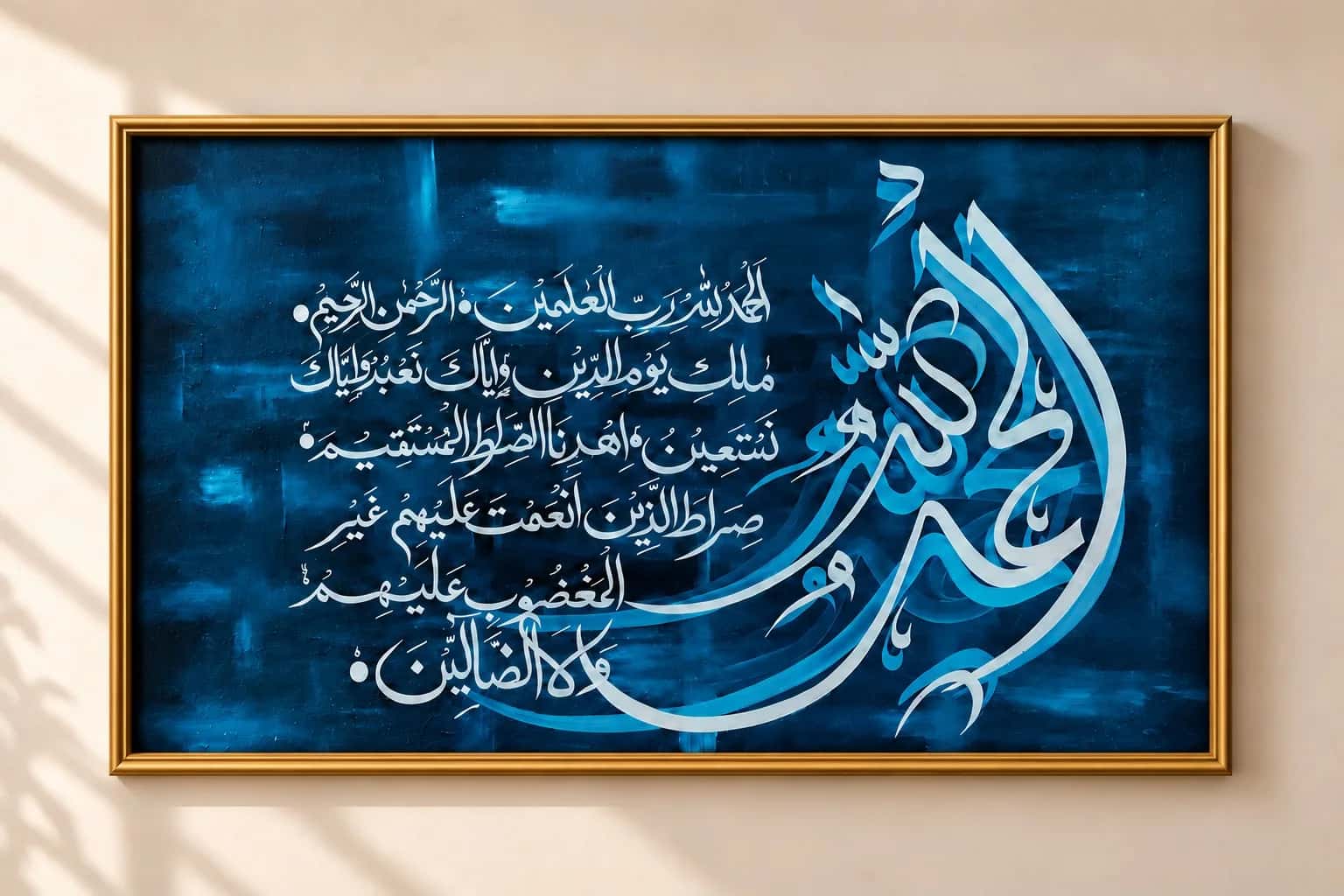
- One phrase large, the rest small.Alhamdulillahi Rabbil-Alamin is painted in bold letters, with the remaining verses in finer script around it. See the Al-Fatiha blue canvas.
- A single verse.Ihdinas-siratal-mustaqim, guide us to the straight path, makes a strong piece on its own for a study or an entrance.
Choosing the right piece
- Readable beats ornate. Since everyone knows the words, people will read along. Choose a script and size that allow it.
- Landscape for living rooms. The seven verses fall naturally into wide lines, so most Al-Fatiha pieces are landscape and sit well above a sofa or console. The size guide explains how wide to go.
- Traditional or modern. Blue, green and gold borders echo historic Qurans. Flat colour with bold lettering feels contemporary. Both are right; choose for the room.
Common questions
- How many verses does Al-Fatiha have? Seven. In the numbering used in most printed Qurans today, the Basmala is counted as the first of them.
- Why is it called the seven oft-repeated verses? Because its seven verses are recited again and again, in every unit of every prayer.
- Is a single verse from it enough for a painting? Yes. Alhamdulillahi Rabbil-Alamin and Ihdinas-siratal-mustaqim are both complete sentences and are often painted alone.
Where it belongs
Al-Fatiha suits the rooms where a household gathers and prays: the living room and the prayer room above all. It is also a classic gift for parents, teachers, a new home or a mosque. Browse Surah Al-Fatiha art and Quran chapter art, see the prayer room page, or read about other complete surahs in our article on short surahs as wall art.
Sources
- Quran translation: Saheeh International, as shown in the InkByHand Verse Library.
- Sahih al-Bukhari 4474 and Sahih Muslim 395.
Artwork in this article
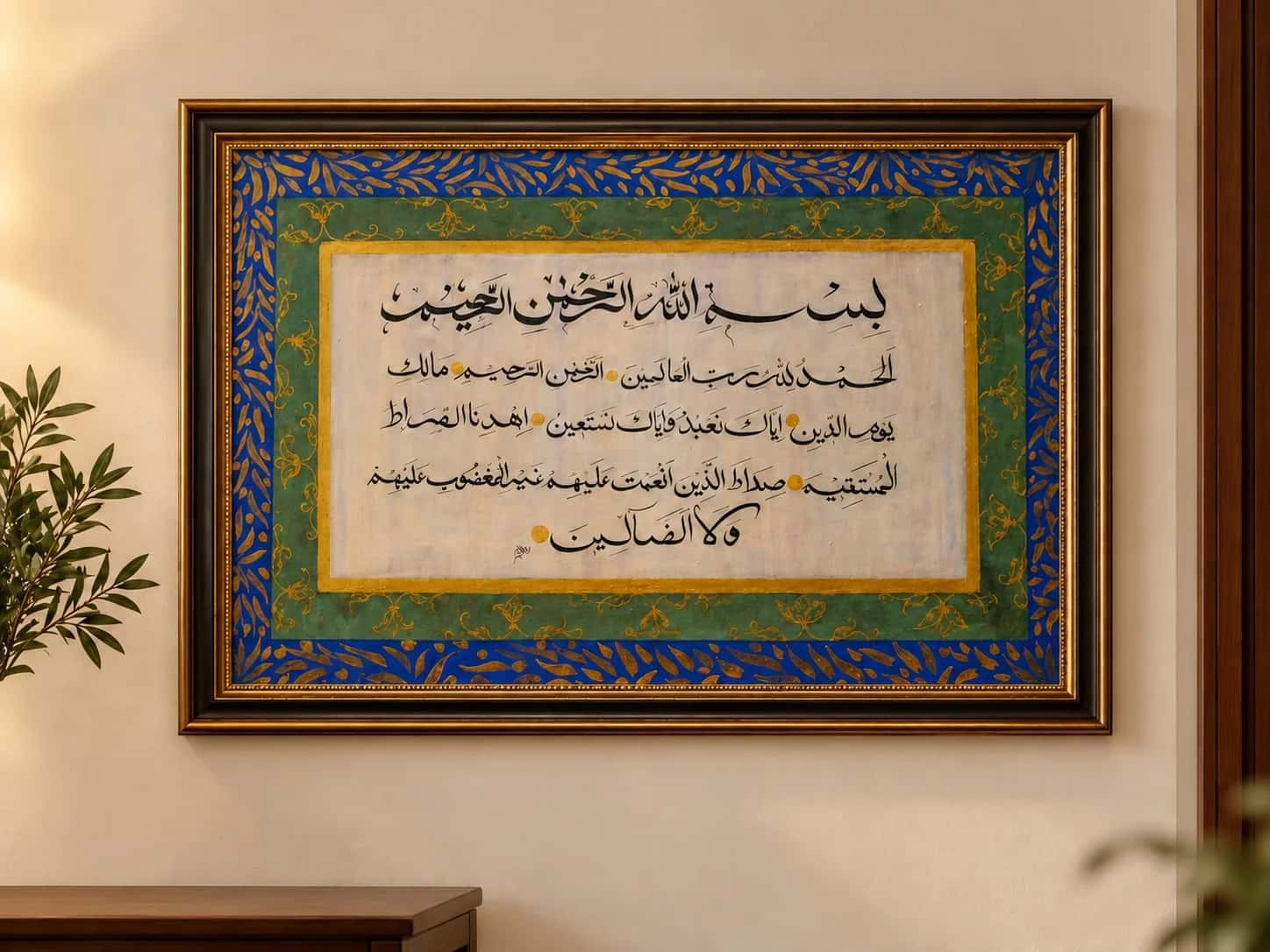
Surah Al-Fatiha Illuminated Border Calligraphy Canvas