Kun Fayakun: The Meaning of “Be, and It Is”
Few phrases are as short or as loved. Kun fayakun is two words in Arabic and four in English: “Be, and it is.” People write it in notebooks, share it in hard weeks, and hang it where they will see it every morning. This article looks at what the words mean and where they come from.
Word by word
- Kun is a command: “Be.”
- Fa is a small connecting word meaning “and so” or “then”, showing that what follows happens at once.
- Yakun means “it is” or “it comes to be”.
Put together, the phrase says that when Allah wills something, His command is enough. Nothing has to be gathered, built or waited for.
Where it appears in the Quran
The phrase appears eight times: in Al-Baqarah 2:117, Aal Imran 3:47 and 3:59, Al-An'am 6:73, An-Nahl 16:40, Maryam 19:35, Ya-Sin 36:82 and Ghafir 40:68. The best-known is the verse near the end of Surah Ya-Sin:
“His command is only when He intends a thing that He says to it, "Be," and it is.” (Ya-Sin 36:82)
The settings are worth knowing, because they show what the phrase is about. It is used for the creation of the heavens and the earth. It is used when Maryam is told she will have a son, and she asks how that can be. It is used for the creation of Adam, and for the raising of the dead. Each time, it answers the same human question: how could that possibly happen?
Read the verse in Arabic with transliteration on the Kun Fayakun page.
Why people hang it
Most people come to this phrase while waiting for something: a child, a marriage, a recovery, a job, a visa. It does not promise a particular outcome. It reminds the reader who decides outcomes, and that difficulty is not an obstacle for Him. That makes it a verse about hope and about humility at the same time, and a natural companion to the verses of trust in our article on tawakkul.
Choosing a Kun Fayakun piece
- Let it be bold. With only two words, the lettering can be large. This is a phrase that reads well from across a room.
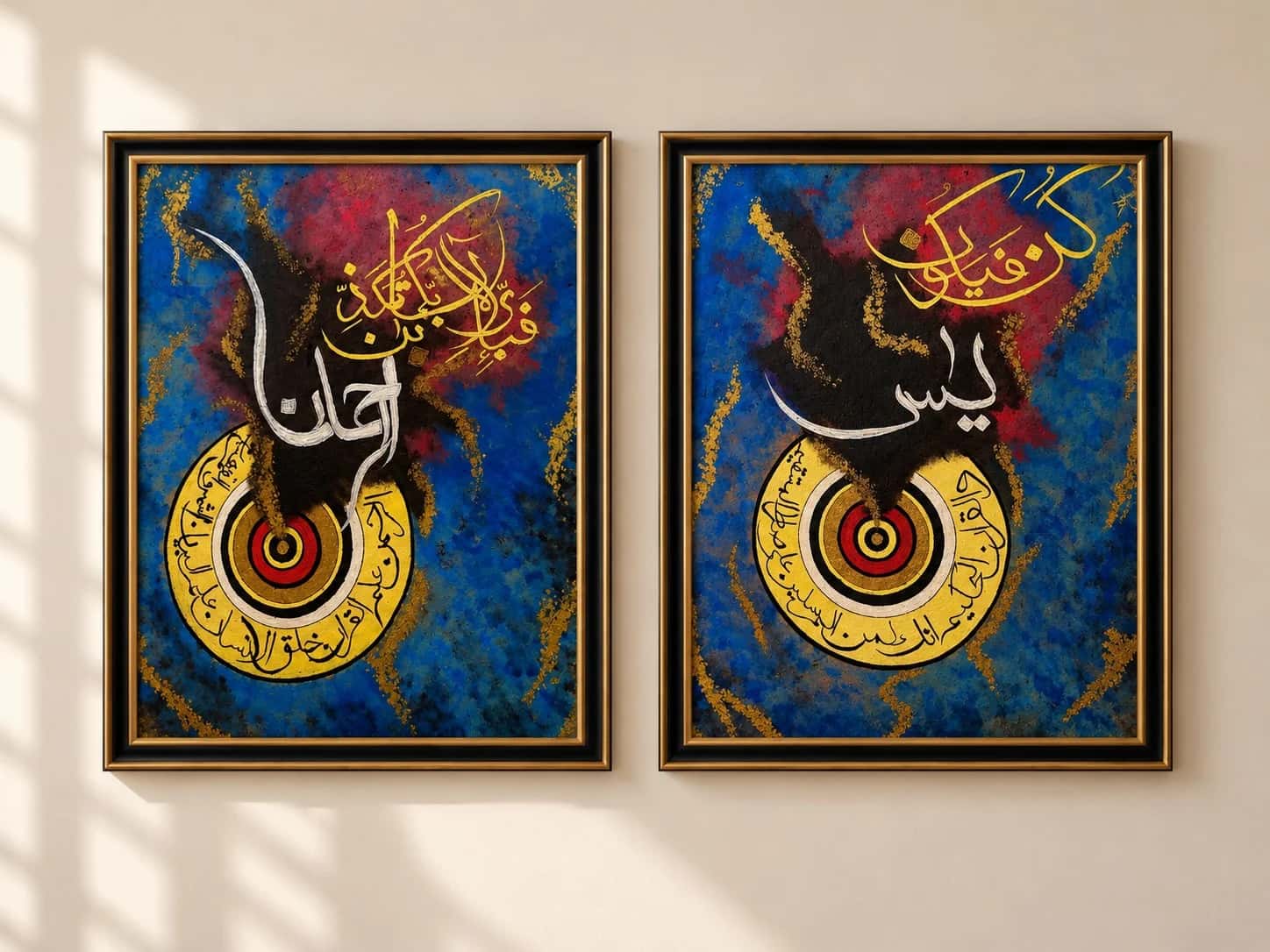
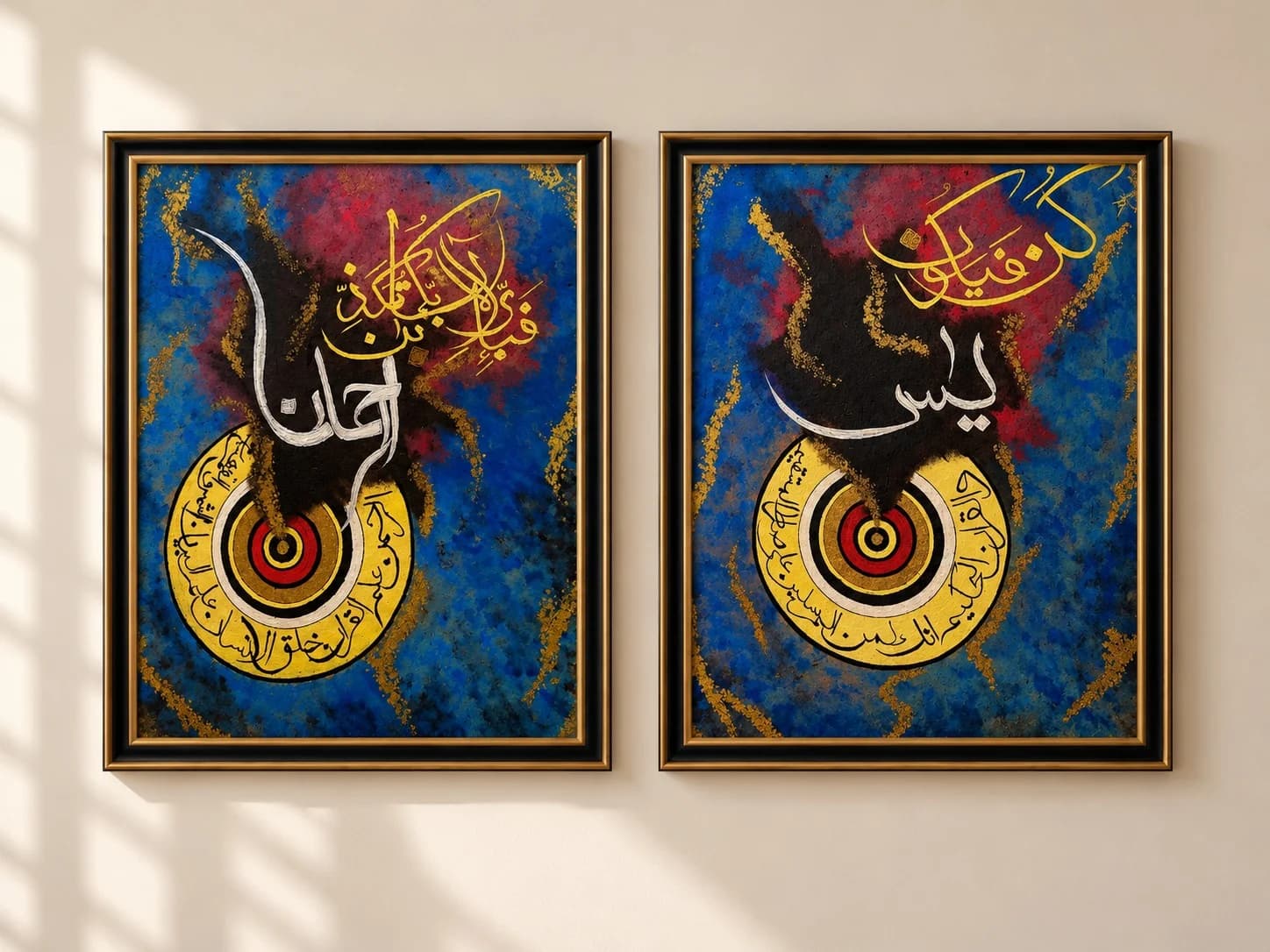
- Consider a pair. Because the phrase closes Surah Ya-Sin, it is sometimes paired with another surah. The Ar-Rahman and Ya-Sin diptych places it above the name Ya-Sin on one panel, with Ar-Rahman on the other.
- Match the mood. Dark backgrounds with metallic lettering feel dramatic; soft, pale backgrounds feel gentle and suit a bedroom.
- Think about who it is for. It is a thoughtful gift for someone at a turning point, as long as it is given with care and not as a comment on their situation.
Where to hang it
Bedrooms, studies and private sitting areas suit this phrase, because it is usually read as a personal reminder. Above a desk it is the first thing you see when work is hard. Follow the usual manners for Quranic text: a clean wall, at eye level or higher. The etiquette guide and the bedroom page give more detail.
To have the phrase painted in your own palette and size, start with the custom artwork process, or browse Quran verse art for ready pieces.
Sources
- Quran translation: Saheeh International, as shown in the InkByHand Verse Library.
- Verse references checked against Quran.com.
Artwork in this article